Logo
Logo
Toggle Menu
Advanced Travel Guide

How to Plan a Multi-City Trip

See more of the world in one go. The comprehensive guide to planning complex itineraries, booking open-jaw flights, and optimizing your route.

Why Multi-City Travel?

Why visit just Paris when you can see London, Paris, and Amsterdam in one trip? Multi-city travel maximizes the value of your long-haul flight. However, it introduces logistical complexity. Here is how to tame the chaos.

The "Open-Jaw" Strategy
Don't book a round trip to City A. Book into City A and out of City B. This saves you the time and money of backtracking to your starting point. Use the "Multi-City" tab on flight search engines.
The Hub & Spoke Model
Pick one major city as your base (Hub) for a week and take cheaper regional flights or trains (Spokes) to nearby cities for 1-2 days, returning to your base. This lets you keep one main accommodation.

5 Steps to Build a Multi-Destination Itinerary

  • 1
    Select Your Anchors: Pick the 2-3 absolute must-visit cities. These will define the skeleton of your route.
  • 2
    Connect the Dots: Look at a map. Does it make sense to go North to South? Or in a loop? Check train connections (e.g., Eurostar) vs budget flights.
  • 3
    Check "Lost Time": Calculate travel time between cities. If a flight is 2 hours, the total door-to-door time is likely 6 hours (airport transit, security, grind). Is it worth it for a 2-day stay?
  • 4
    Book Main Flights First: Secure your long-haul into the first city and out of the last city.
  • 5
    Fill the Gaps: Now book the inter-city trains or regional flights.

Let AI Optimize Your Route

Humans aren't great at solving the "Traveling Salesman Problem" (finding the most efficient route between multiple points). AI is.

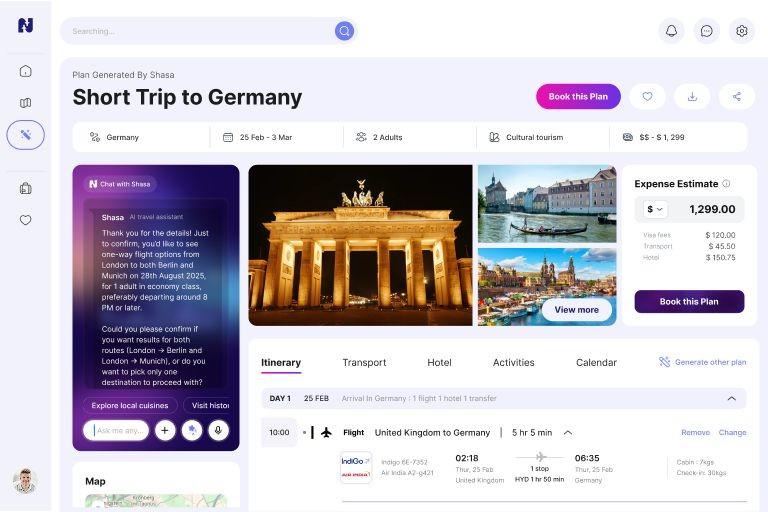
Use NxVoy's Multi-City Planner to input "I want to visit London, Paris, and Rome in 10 days". It will tell you the best order to visit them to save money and time.

Common Questions